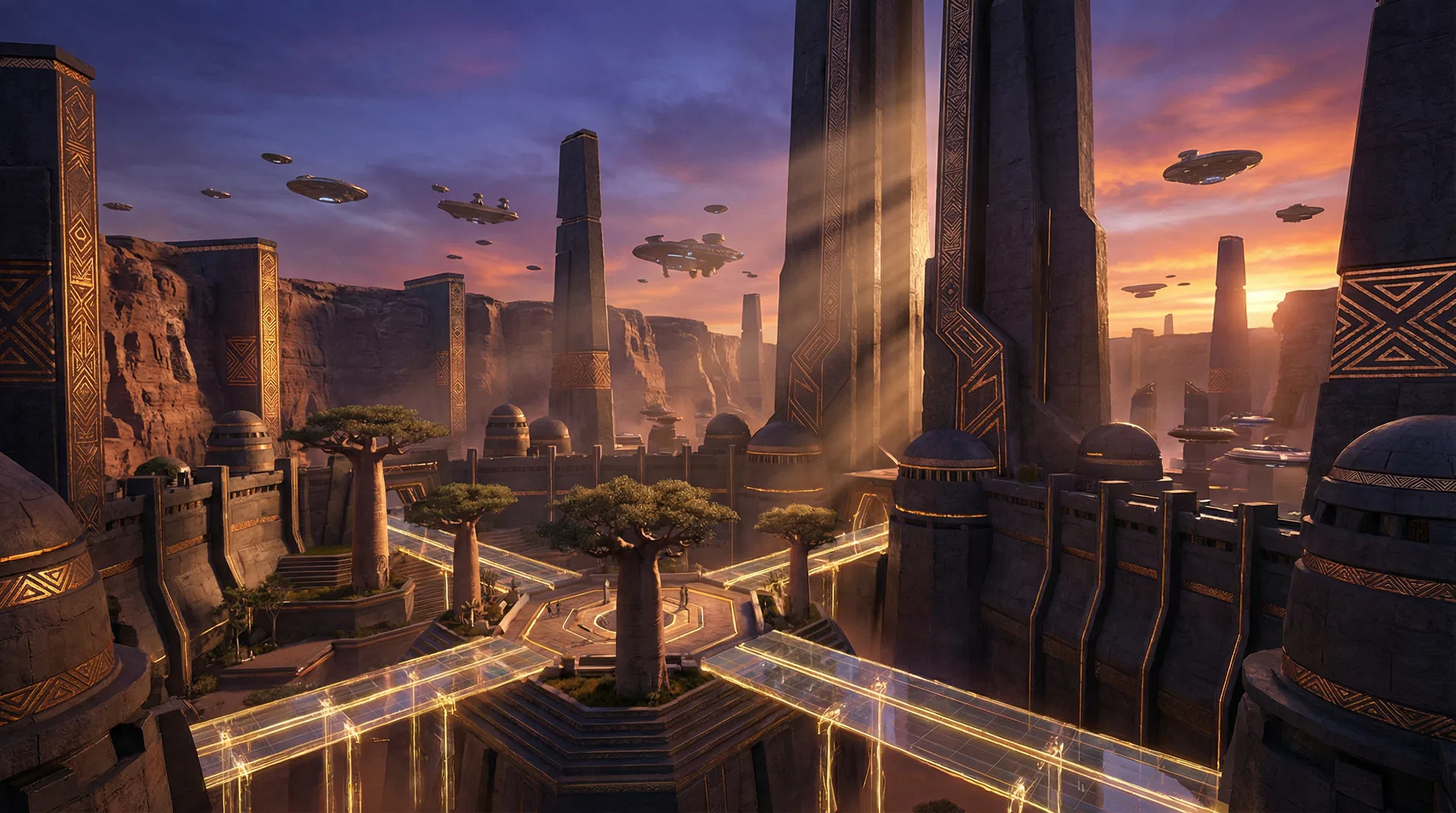

Born from the ashes of the Great War, a sovereign civilization rises. The Throne of Muntu commands an empire where ancestral power and living technology are one.
In the aftermath of the Great War, the peoples of Southern Africa did not simply rebuild — they reclaimed. From the ruins rose the Throne of Muntu, a sovereign civilization rooted in Southern African identity, ancestry, and power.

"The Throne of Muntu is not merely a seat of power — it is the living covenant between the ancestors and the empire. To hold the Throne is to carry the weight of all who came before."
— Royal Protocol of the Throne of Muntu
Muntu™ is an African Futurism mythos rooted strictly in Southern African societies, cosmologies, and traditions. In the aftermath of the Great War, it was the peoples of Southern Africa — the Nguni, the Sotho, the Shona, the Tonga, the Venda, and their kin — who rose from the ruins and restructured the world around their own identity, ancestry, and sovereign power.
The Throne of Muntu is a centralized imperial authority built on Southern African cosmology, political tradition, and ancestral reverence. Its languages, its rituals, its architecture, its philosophy of power — all draw from the living cultures of the Southern African region. This is not a borrowed mythology. It is an original one.
The political and ceremonial heart of the empire. A hyper-advanced metropolis where royal power is exercised, ancient traditions coexist with futuristic technology, and the Throne resides.
The empire's economic engine. A dense, modern urban expansion zone where commerce, culture, and ambition converge. The pulse of Muntu's civilian life.
Volatile, mysterious, and often lawless. The frontier territory where the empire's reach grows thin and ancient forces stir beneath the red earth.
Human settlements on Mars and the Moon, extending Muntu's sovereign reach beyond Earth. The empire's claim on the cosmos.

Volatile. Mysterious. Lawless. Where the empire's reach grows thin and ancient forces stir.

A centralized imperial authority governing a technologically advanced, spiritually aware society rooted in African cosmology, political hierarchy, and ancestral reverence. The Throne is not inherited — it is earned, contested, and consecrated.
The Throne of Muntu is a centralized imperial authority — the supreme governing body that all Seven Nganda must ultimately answer to when one of them ascends to power.
A supreme governing doctrine that regulates imperial authority, defines succession, conduct, and rulership standards. It overrides all individual Nganda customs when ruling the empire.
Power is not merely political — it is ancestral. The Throne is the living covenant between the empire and those who came before. Lineage and legacy define legitimacy.
Despite the rivalry of the Seven Nganda, the Throne demands unity. When a Nganda rules, it submits to the higher doctrine — the empire above all Nganda loyalties.
The empire is governed through a system of seven elite Nganda, each with distinct cultural identity, internal governance systems, and unique philosophies of power. These Nganda rotate or compete for dominance over the Throne.
When a House ascends to power, it must submit to the Royal Protocol of the Throne of Muntu — a supreme governing doctrine that regulates imperial authority and overrides individual House customs.
A sacred order of dreamwalkers and spiritual intermediaries. They hold no political power but serve as advisors on spiritual, ancestral, and metaphysical matters. Their influence is subtle but critical.
Nganda — Bemba for "House" · Nganda Ya — "House of"
Seven elite Nganda, each with distinct cultural identity, internal governance systems, and unique philosophies of power. They rotate and compete for dominance over the Throne of Muntu — but when one rules, all must submit to the higher doctrine.
Military & Defense
The Unbreakable
The oldest and most battle-hardened of the Seven Nganda. Nganda Ya Ndlovu commands the empire's military forces and has held the Throne more times than any other. Their philosophy of endurance and strength has shaped the empire's martial identity for generations.
"Strength through endurance. The mountain does not move — the storm passes."
TAP TO REVEAL ↓
Governance & Law
The Sovereign
Masters of governance and imperial law. Nganda Ya Inkosi has produced more Throne-holders than any other in recent memory. They are the architects of the Royal Protocol itself, and their interpretation of law shapes the empire's future.
"Leadership is not taken — it is recognized by those worthy of following."
TAP TO REVEAL ↓
Moyo Ferum & Technology
The Awakened
The custodians of Moyo Ferum — the living metal that powers the empire. Nganda Ya Elyrion controls the mines of Elyrion and the refinement facilities that supply the empire's energy. Their technological mastery makes them indispensable.
"Moyo Ferum does not serve the unworthy. Lineage is the key that unlocks power."
TAP TO REVEAL ↓
Commerce & Urban Development
The Prosperous
The economic powerhouse of the empire. Nganda Ya Khaleni built and controls Khaleni City, the empire's primary commercial hub. Their wealth is vast, their networks extensive, and their influence in civilian life unmatched.
"The empire is fed by commerce. Gold flows where wisdom guides it."
TAP TO REVEAL ↓

Sovereign Matriarchy & Political Design
The Matriarchs of Deliberate Power
Founded on one central belief: women must never again be invisible in power. Nganda Ya Tao does not exclude men — it restructures authority. Influence is shared. Sovereignty is female. The Matriarch is not symbolic. She is the House embodied. Led by a single Matriarch who wears white and gold, marked by permanent white ink tattoo — the covenant of sovereign authority.
"Power must be seen. Leadership must be earned. Sovereignty must be embodied."
Colors
White & Gold
Marking System
White Ink (Sovereign) · White Paint (Delegated) · Black Ink (Deposed)
Succession
Competition — not inheritance. All women must prove themselves.
TAP TO REVEAL ↓
Spiritual & Ancestral Affairs
The Dreaming
The most spiritually attuned of the Seven Nganda, with deep ties to the Nzali order. Nganda Ya Nzali does not seek the Throne through force — they seek it through destiny. Their dreamwalkers see paths others cannot. They are the empire's conscience in political form.
"The ancestors speak to those who know how to listen. Destiny cannot be forced."
TAP TO REVEAL ↓
The Capital & Imperial Legacy
The Eternal
The founding house of Mukalenga Prime itself. Nganda Ya Mukalenga's identity is inseparable from the capital city. They are the keepers of imperial history, the curators of legacy, and the architects of what the empire means to its people.
"The capital is not a place — it is an idea. And ideas cannot be conquered."
TAP TO REVEAL ↓

The Red Verge is not a Nganda. It is a wasteland — a vast, desolate desert territory beyond the empire's borders where the cast-out are sent and the forgotten survive. Outcasts, mutants, and those deemed undesirable by the empire's order are exiled here.
Among those who dwell in the Red Verge are Nzali who have strayed from the sacred order — practitioners of dark magic, those who have broken the ancestral covenant, and those whose power has been deemed a threat to the balance of the empire. The Red Verge is where the empire's conscience goes to die. Or to be reborn.
LIVING METAL · THE FOUNDATION OF MUNTU'S POWER

Energy Signature
ACTIVE · SENTIENT
Moyo Ferum is not merely a resource — it is the heartbeat of the Muntu civilization. A rare, semi-sentient material sourced from Elyrion, it blurs the line between technology and life. It powers cities, weapons, and infrastructure. It responds to human interaction — especially to lineage and spiritual alignment.
Those of pure lineage and strong spiritual alignment can interface with Moyo Ferum at a deeper level — commanding it, shaping it, drawing power from it that others cannot access. This is why control of Moyo Ferum is not merely economic. It is existential. Control of Moyo Ferum is control of the future.
Elyrion
Sourced from the mineral-rich depths of Elyrion — a region of the empire where the boundary between earth and energy is thinnest.
Semi-Sentient
Moyo Ferum is not merely metal — it is alive. It responds to human interaction, particularly to lineage and spiritual alignment. The worthy feel it pulse.
Universal Power
Powers cities, weapons, and infrastructure across the empire. From the lights of Mukalenga Prime to the engines of off-world colony ships.
Control = Future
Control of Moyo Ferum is control of the empire's future. It is the most contested resource in the known world — and the most dangerous.
"Control of Moyo Ferum is control of the future."
— Muntu Universe Codex, Volume I
SACRED ORDER · DREAMWALKERS · SPIRITUAL INTERMEDIARIES
"The Nzali do not seek power. They seek truth. And in the Muntu Universe, truth is the most dangerous thing of all."
The Nzali are a sacred order of dreamwalkers and spiritual intermediaries. They do not hold political power and cannot dethrone rulers. Yet their influence is subtle and critical — especially in matters involving destiny, ancestral judgment, and the balance between the physical and unseen realms.
They serve as advisors on spiritual, ancestral, and metaphysical matters. The Nzali are the empire's conscience — the voice of the ancestors in a world increasingly seduced by power and technology. A civilization that silences its Nzali silences its own soul.
Destiny
Ancestral Judgment
Balance

The Nzali can traverse the boundary between the physical world and the unseen realm. In the dream-state, they commune with ancestors, read the threads of destiny, and perceive what is hidden from mortal sight.
They serve as the bridge between the living and the ancestral realm. When the empire faces decisions of great consequence, the Nzali are consulted — not commanded.
The Nzali hold no political power and cannot dethrone rulers. But their counsel shapes the decisions of those who do. A ruler who ignores the Nzali ignores the ancestors — at their peril.
Their primary function is maintaining the balance between the physical and unseen realms. When that balance is disturbed — by ambition, by war, by the misuse of Moyo Ferum — the Nzali are the first to know.
The Muntu Universe is driven by layered tensions — internal, spiritual, and territorial. No conflict exists in isolation. Every war is also a spiritual crisis. Every political rivalry is also a battle for ancestral legitimacy.
The Seven Nganda are in constant competition for dominance over the Throne. Political manipulation, legacy-building, and strategic alliances define the internal landscape of the empire.
Individual Nganda ambitions frequently clash with the Royal Protocol of the Throne. The tension between what a Nganda wants and what the empire demands is a constant source of conflict.
Who has the right to rule? Succession disputes are rarely simple — lineage, spiritual alignment, and political power all play roles in determining who is worthy of the Throne.
The Nzali's interpretations of destiny frequently conflict with the ambitions of the ruling Nganda. When the ancestors speak one path and a Nganda desires another, something must give.
The will of ancestors versus human ambition is the oldest conflict in the Muntu Universe. Some rulers honor the ancestral covenant; others believe they can forge their own destiny.
As Moyo Ferum becomes more central to power, the question of its spiritual nature intensifies. Is it a gift from the ancestors — or a force that will ultimately corrupt those who wield it?
The Red Verge is not governed — it is endured. A desolate wasteland beyond the empire's borders, it is home to outcasts, mutants, and those cast out of the Nganda order. It is where the empire's authority ends and something older begins.
The Mars and Moon colonies represent the empire's future — and a new arena for Nganda rivalry. Who controls the off-world colonies controls the empire's next century.
Access to and control of Moyo Ferum deposits is the most strategically vital territorial conflict. The Nganda that controls the supply controls the empire's power source.
The empire advances technologically while its identity remains rooted in ancestral custom. The two are not always compatible.
Moyo Ferum blurs the line between machine and spirit. As technology advances, the spiritual foundations of the empire are tested.
Every Nganda member owes loyalty to their Nganda — but the empire demands unity above all. This tension is never fully resolved.

SOVEREIGN RESERVE CURRENCY · MOON BASE · ELYRION PACT
The Umwe — derived from the concept of oneness — is not a trade-driven currency. It is a sovereign reserve currency, designed for stability, control, and long-term power. It is backed by a resource that cannot be replicated, synthesized, or stolen without consequence.
The Umwe functions as a closed, high-trust currency — strengthened by scarcity, discipline, and the Elyrion Alliance. No raw material is exported. No dependency on foreign markets exists. Limited external Umwe circulation ensures that its value is never subject to the volatility of the outside world.
Living Metal Properties

UMWE (UMW)
Official Currency of Muntu
Unity
Derived from 'oneness' — the Umwe reflects the unity of the Seven Nganda under a single sovereign civilization.
Stewardship
The living metal is never sold, exported, or traded. It is protected and used for advancement — not exploitation.
Loyalty
The Elyrion–Muntu Pact is built on mutual protection. Any misuse of the metal risks immediate termination of access.
Scarcity
The Umwe's strength comes from what it cannot be: replicated, diluted, or compromised by foreign markets.
Living metal is extracted from Elyrion's mineral-rich depths — the only known source in the known world.
The metal is stabilized in secure containment units before transport. Unstabilized metal is volatile and unpredictable.
Sealed cargo vessels travel interplanetary routes under armed escort by Muntu's specialized task force.
The Moon Base is the primary transfer point — and the most contested location in the entire supply chain due to its neutral status.
A portion of the metal is routed to the Mars Colony for advanced research and off-world infrastructure development.
The bulk is transported to Muntu's Earth reserves, powering cities, weapons, and the Umwe currency itself.
Because the living metal cannot be replicated or mined elsewhere, the only way rivals can obtain it is through theft. Muntu operates a specialized interplanetary task force to protect every point in the supply chain.
Foreign-backed piracy operations target interplanetary shipments between Elyrion and the Moon Base.
Covert interception attempts at lunar checkpoints exploit the Moon Base's neutral territorial status.
State-level espionage operations target Muntu's processing technology — the only way to use the metal without the Pact.
"The Umwe is not just currency — it is a reflection of Muntu's philosophy, power, and interplanetary alliances. Unity over division. Stewardship over exploitation. Loyalty over opportunism."
— Muntu Universe Codex, Volume II